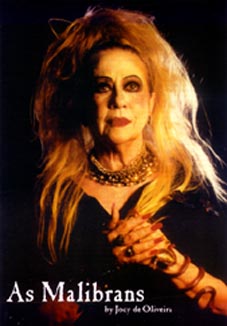
This music theater piece is the third part of a trilogy with focus on women values.
Conceived for 3 singers, one actress, oboe, clarinet, cello, piano and electroacoustic means with computer generated sounds.
lt brings up the dark side of a Diva, her voice and her role as an opera personage.

In the great majority of traditional opera librettos, the female personage is always destined to submission or condemned to death. Through opera history and also in real life, these "Divas" with their divine voices, fantasized as goddesses , were often driven to loose their mental sanity.
Although this piece is conceived in a more sonorous than verbal language, some quotations of opera texts, Jules Verne, and women writers such as Catherine Clement, Maria Malibran besides the author herself are inserted in the score.

lt does not present a linear narration, however a great part of reconstructed images are based on the cult figure of Maria Malibran. She becomes the archetype of the theme and represents a new type of woman born before 1830.
According to Catherine Clement "The role of women in opera perpetuates the social patriarchal order through the imposition of death or in the process of domestication- in the role of heroine- victim"

An intermittent video, as a virtual set, binds all the scenes. The sound material is an electroacoustic tape built from very short fragments from opera arias sung by deceased Divas. These voices are processed through various means of filtering and cross synthesis, creating a mutable and hybrid sound universe.
By the end, a Diva sings and tells a story based on the fascinating gothic novel - "The Carpathian Castle" by Jules Verne, a fiction about the story of a famous "Diva" -(La Stilla) inspired by the life of Malibran

Maria Malibran's extraordinary life encompasses all the triumphal magnitude from a career which consecrated her as the Diva of her time with the anguish and sufferance that this role perpetuates.
"As Malibrans" was premiered in May 2000 at the Staatstheater Darmstadt, Germany and in December 2000 at the Teatro Carlos Gomes, Rio de Janeiro, Brazil. Both productions directed by Jocy de Oliveira.A new dance theater production with the Staatstheater cast in Darmstadt directed by Birgitta Trommler was presented from October 2000 to January 2001
CD recorded to be released in Brazil and the USA , 2001.
Video recorded in its complete version by TV Educativa, Rio de Janeiro, Brazil.